Sant Joan en Barcelona: por qué seguimos celebrando el fuego
Compartir
Sant Joan always arrives in the city with the energy of that friend who texts "relax, just a quick beer" and twelve hours later you find yourself barefoot on a beach, smelling of smoke and making decisions that your nine-in-the-morning self would denounce in an international tribunal. For a few days, Barcelona stops trying to look like an efficient, sustainable, and slightly Scandinavian European capital and goes back to being what it has always been: a Mediterranean port where people consider it perfectly reasonable to celebrate the start of summer by throwing small explosives near their relatives. Bakeries display cocas as if they were jewelry stores, supermarkets become logistics centers for ice and beer, and children handle firecrackers with the concentration of an underpaid nuclear engineer. The entire city acquires that atmosphere of an important eve, as if we all knew something is about to happen even though we’ve been doing it for centuries.
The saint came after the fire
The Church says we are celebrating Saint John the Baptist and technically it is true, just as technically airport pizza is also pizza. The saint came later. Much later. Before him, there were already bonfires, night swims, solstice parties, people jumping over fire, and agricultural communities trying to negotiate with the gods, the harvests, and bad luck through an ancestral strategy that basically consisted of lighting something on fire and hoping for the best. Christianity saw that it had more followers than any institutional campaign and decided to do what big brands have been doing for centuries: put a new name on a custom too popular to ban. The saint came after the fire, not the other way around.
And perhaps that is why the party still works. Because underneath the saint, the coca, the verbena, and the WhatsApp groups organizing dinners, there is something much older. What is extraordinary is that we continue to gather around the fire after having invented the internet, cryptocurrencies, productivity apps, and Zoom meetings. We have managed to give a toaster Wi-Fi connectivity and yet, June arrives and we decide to stare at a bonfire for twenty minutes with the same fascination as an Iberian shepherd from two thousand years ago. Anthropologists talk about liminal rituals and pagan survivals. The reality is that fire still has a better interface than many apps.
Celebrating just when the light begins to fade
There is also something deeply Mediterranean about celebrating precisely the moment when the light begins to wane. The solstice does not mark a victory but the beginning of a loss. The days will never be that long again, and the collective response consists of organizing a huge party, lighting a fire, and drinking cold white wine. Northern peoples built entire philosophies around melancholy; here we invented verbenas. They developed seasonal depression and we decided to respond to the passing of time with a firecracker and a bottle that someone will forget in the freezer.
As one crosses the city on the night of Sant Joan, one also discovers that social classes become slightly porous. The lawyer, the waiter, the student, the lifelong family, and the accidental tourist end up looking at the same sky for a few seconds while a particularly ambitious firework explodes. Later, everyone will return to their specific problems, their mortgages, or their impossible rents, but for a few hours there is that strange suspension of the daily order. Fire has always been democratic because it forces everyone to keep a certain distance and because a stray spark does not distinguish between neighborhoods, professions, or bank accounts.
A party that never had a single meaning
Perhaps that is why we continue to celebrate Sant Joan when so many other holidays have lost part of their meaning. Because, in reality, it never had just one. It is a religious holiday for some, pagan for others, a family one for many, and purely logistical for those who are just trying to get their dog to survive the firecrackers. But underneath all those layers remains a very old idea: human beings need to mark time with something more than digital calendars and work meetings. We need nights that feel different, moments that separate one season from another, small ceremonies that remind us that we continue to live within cycles much older than ourselves and that, no matter how much we try to organize life into apps, we are still quite ancient animals sitting around the fire trying to understand what to do with the time allotted to us.
So, happy Sant Joan. May whatever is left burn, may what is important survive, and may the firecrackers always explode a little further from our feet than from our expectations. See you on the other side of the night, smelling of smoke, sand in our sneakers, and the suspicion that some traditions still exist because, despite everything, they still know more about us than we do ourselves.
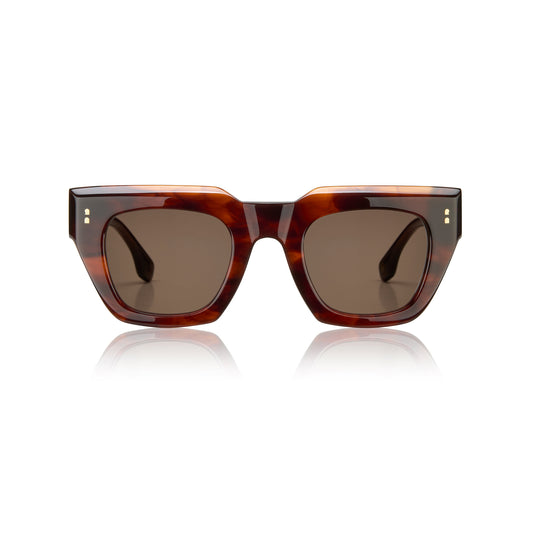
RAVAL was born in El Raval, the neighborhood that has spent centuries celebrating the longest night of summer. We design glasses to look at the city —and the fire— with new eyes.