"No hace ni veinte años que sabemos hacer esto": el sermón de 1306 que fecha el invento de las gafas
Compartir
On February 23, 1306, in a church in Florence, a Dominican friar named Giordano da Pisa was giving a sermon (one of those long winter ones, with people packed in and the cold seeping in from everywhere) when he dropped a casual remark that is likely the most important document in the history of optics today. He said, more or less: it is not yet twenty years since the art of making eyeglasses was discovered, which are among the best and most necessary arts that the world has. And then he added what truly makes your hair stand on end: I myself saw the man who first discovered and made them, and I spoke with him.
I saw the man. I spoke with him.
Someone who realized it in real time
The extraordinary thing about that sentence is not the date, even if the date is pure gold for historians. It is that Giordano was aware. He was alive at the exact moment the invention appeared, he understood it was important, he took the trouble to say it out loud, and he left a record. That is extremely rare. Practically everything that has changed the world went unnoticed while it was happening: people who lived through the invention of the printing press, the steam engine, or the internet took decades to understand what had hit them. Here, however, there is a man in an Italian church in 1306 saying, in essence: what has just happened is huge, and I knew the guy.
And yet—and here is the unbearable part—he did not tell us the name.
The most useful invention of the millennium was signed by no one
That is the great void of history. Eyeglasses appeared in northern Italy around 1286, probably between Pisa and Venice, with all the logic in the world: it was the area of Europe where glass was best worked and where there were the most people whose profession consisted of reading small print for hours—copyist monks, notaries, merchants with ledger books—that is, the highest concentration of eyestrain on the continent. We know that a certain Alessandro della Spina, a Dominican from Pisa, learned how to make them and, unlike the original inventor, taught everyone how they were made. His funeral eulogy states it bluntly: another invented them and did not want to share the method; he remade them and shared it with everyone, gladly.
Translation: the first one kept it to himself. He had an industrial secret in his hands, understood what it was worth, and decided it was his. And the result, eight centuries later, is that some two billion people put his invention on their faces every day without having the slightest idea who to thank. It is the most elegant revenge history has ever executed against someone for not sharing: it did not punish him with the oblivion of his work, which survives on faces all over the planet, but with the oblivion of his name.
Three hundred years without temples, because no one was in a hurry
Another detail that says a lot about how innovation really works. Those first glasses were two convex lenses mounted in rims joined by a rivet, and they were not attached to anything. They were held by hand, or rested precariously on the nose, or tied with ribbons to a hat. No one thought of temples.
No one thought of temples for four hundred years.
Think about it for a moment, because it is one of the most human things that exist. Entire generations of highly intelligent people—astronomers, cartographers, mathematicians, scientists who were meanwhile rearranging the entire universe—holding their lenses with one hand and turning pages with the other, without any of them occurring to them that they could rest on their ears, which had been there from the beginning and were not doing anything. Side temples did not become widespread until the 18th century. The obvious solution is always centuries late, and always seems obvious only afterward.
The north would have patented it; the south tells it in a sermon
There is something very Mediterranean about this whole story, said with affection. An invention that appears without a deed, without a registration, without a name; a friar who documents it by accident while talking about something else; a second manufacturer who blows the first one's secret simply because he thought it was wrong to keep it; and all of humanity benefiting from a chain of events that no innovation department would have ever approved. In northern Europe, this would have generated a patent, a twenty-year lawsuit, and a museum with an audio guide. Here, it generated a winter sermon and a funeral eulogy.
Neither one is better. But it is likely that the best invention of the Middle Ages remains authorless because it happened in a place where people were busier using things than registering them.
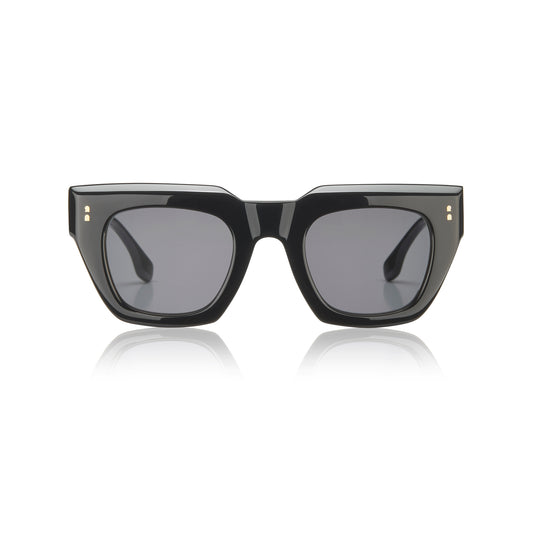
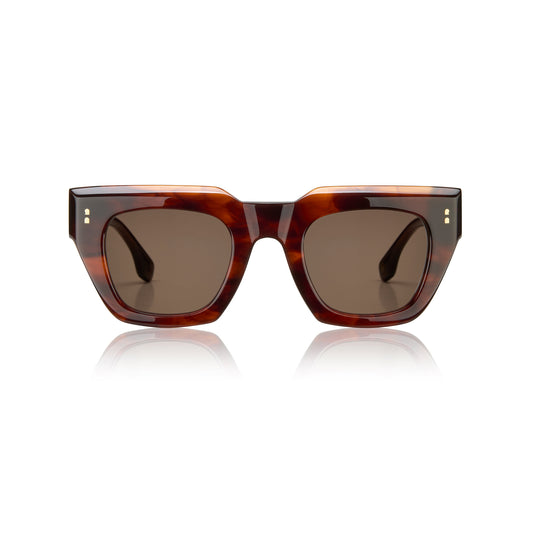
At RAVAL, we work with an object that carries eight hundred years of anonymous people improving it little by little: someone added the rivet, someone added the bridge, someone, four centuries late, stumbled upon the ear idea. We didn't invent anything. We add, if anything, a small chapter to a book that someone else started and never signed.
Who invented glasses? It is not known. They appeared in northern Italy around 1286 and the inventor kept the method secret. In 1306, the friar Giordano da Pisa left a record in a sermon that he had personally known the inventor, but he did not record his name.
RAVAL designs glasses in Barcelona, in El Raval. Culture, not catalog.