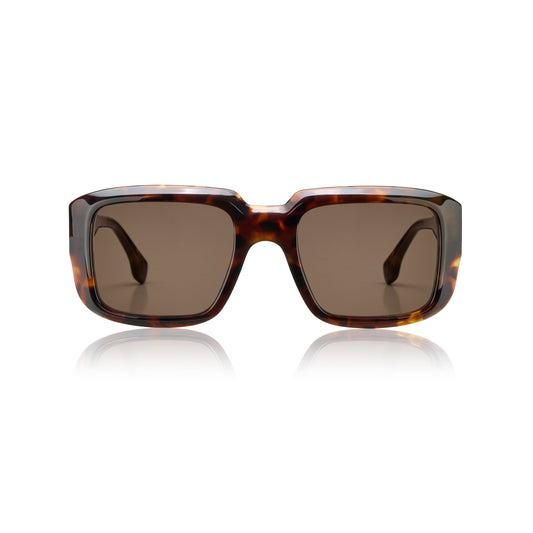
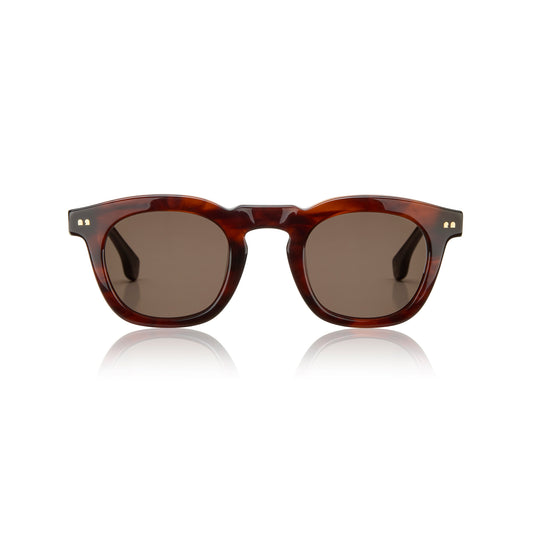
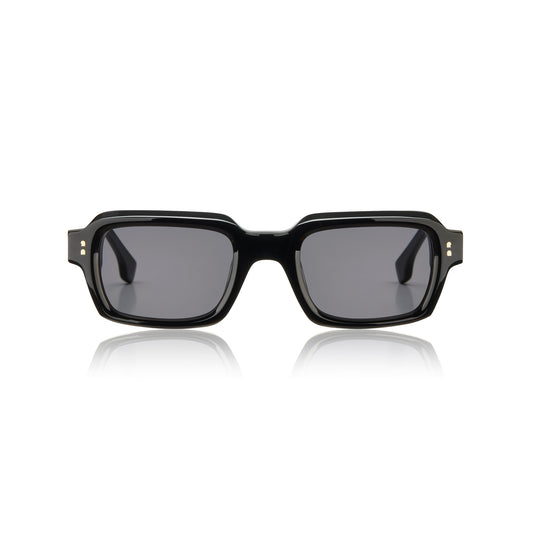
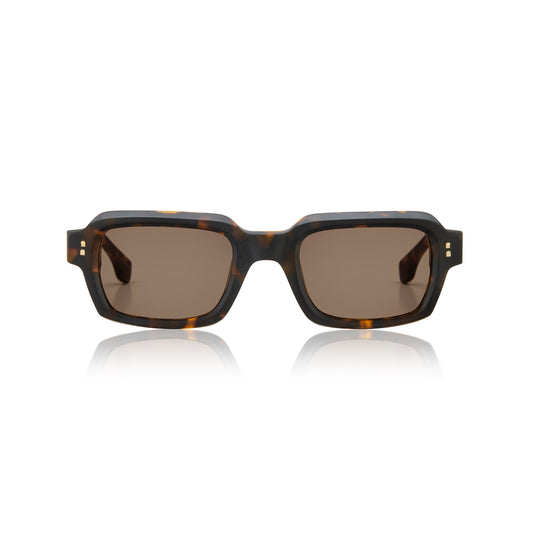
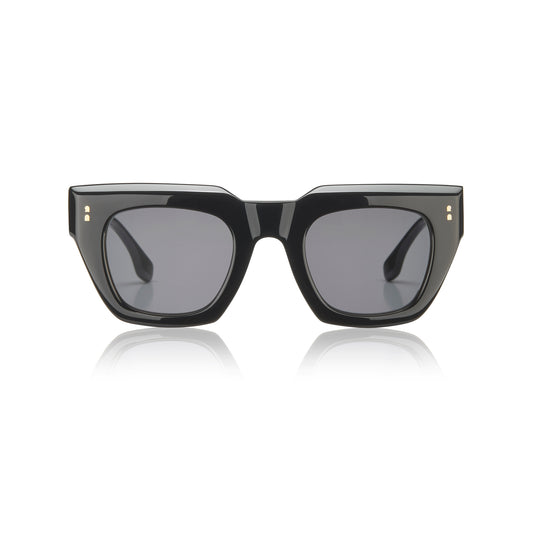
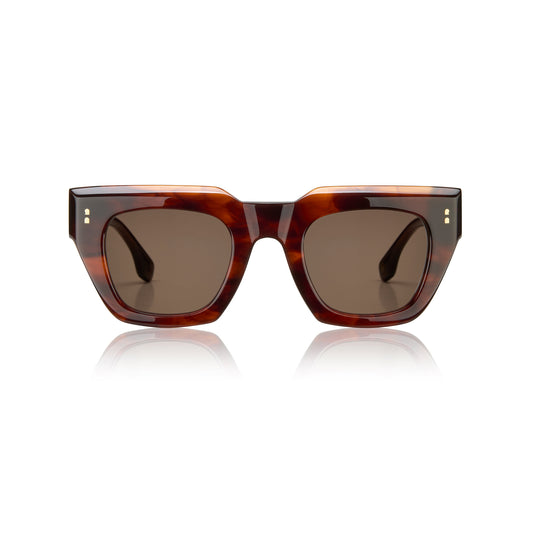
How to choose sunglasses: the face-shape rule was invented by a make-up man
Share
There is a universal moment, shared across every culture and every budget, which consists of standing in front of the small swivelling mirror in an optician's shop wearing a pair of sunglasses and making a face you have never made in your life. It is a very specific expression: chin slightly raised, mouth at rest, three-quarter gaze, a general air of considering something important which you are not. Nobody looks like that in the real world. Nobody walks down a street like that. And yet it is the face we use to decide which glasses we will be wearing for the next three years, which is roughly like choosing a mattress by testing it standing up.
The rule everybody repeats and nobody has checked
The first thing you will be told, in any shop and in any article, is that you should choose the frame according to the shape of your face. Round face, angular frame. Square face, round frame. Oval face — congratulations, you may wear anything, have a lovely day. It is repeated with such confidence, in so many languages, that it sounds like ancient knowledge, almost like anatomy, and you assume there must be a serious study behind it somewhere, with large samples and white coats.
There isn't. What there is, is advertising.
The idea of sorting human faces into a catalogue of geometric shapes and then applying an aesthetic correction to each one was popularised in 1930s Hollywood by the make-up industry. Max Factor went as far as building, in 1932, a device called the beauty micrometer: a metal cage bristling with screws and rods, lowered onto an actress's head to measure her facial proportions and identify precisely where she deviated from the classical Greek ideal, so that make-up could correct the deviation. It is one of the more disturbing images in the history of beauty, and also one of the more honest, because at least it wasn't pretending: that was literally a machine for measuring how far you fell short of a statue.
That logic — there is an ideal shape, you don't have it, here is the product that closes the gap — leaked into hairdressing, into fashion and, inevitably, into eyewear. The shapes rule doesn't describe how beauty works. It describes how a counter with several hundred references works, and how a salesperson keeps their sanity in front of it. It is a commercial shortcut dressed up as a law of nature.
What actually matters (and almost nobody checks)
The odd part is that while we're busy debating whether our face is a trapezium or an oval, we cheerfully ignore the three or four things that genuinely decide whether a pair of sunglasses lives on your face or at the bottom of a drawer.
They have to stay put. The only fit that really matters is the bridge. If it sits properly, the frame doesn't slide; if it slides, you will hate it within a fortnight no matter how flattering it looked in the photograph. A test with no mystery to it: look down at the floor. If they move, they aren't your glasses, and no amount of style will fix that.
The lens has to actually protect. Here is the great misunderstanding of the entire category: how dark the lens is has nothing to do with UV protection. A very dark lens with no UV filter is objectively worse than wearing nothing at all, because the darkness dilates your pupil and lets in more radiation than would reach it if you were squinting in full sun. Look for UV400 or the equivalent full-protection marking. The tint is an aesthetic decision, not a medical one.
They shouldn't eat your eyebrows. An unwritten but reliable rule: the frame shouldn't completely cover your brows. Eyebrows are half of your expression, and glasses that erase them turn you into someone other people find difficult to read.
You have to actually wear them. This sounds like a joke and it is the decisive criterion. The good pair isn't the one that performs best in the swivelling mirror; it's the one you pick up off the hall table without thinking, the one that ends up in the pocket of every jacket, the one that gets scratched because it gets used. We all own a pair that is objectively more flattering than the pair we actually wear, and we all know exactly why we don't wear it: we don't recognise ourselves in it.
The north buys functions; the south buys characters
It's worth saying that this varies enormously depending on where you're standing. In northern Europe, buying tends to be an exercise in engineering: filters compared, materials assessed, warranties read, weight in grams noted, the governing question being whether the object will do its job for many years. In the Mediterranean the question is different, considerably less respectable and rather more accurate: who am I with these on? Here a pair of sunglasses isn't bought, it's auditioned. It's tried on in front of three friends, submitted to the opinion of a passing waiter, judged to be too much, and purchased precisely for that reason.
And the south is, at bottom, right — because a frame is the only thing we wear that sits exactly where people look for information when they talk to you. Clothes are noticed afterwards. Shoes, at best, on the way out. The face is read first and always, and on a face a pair of glasses isn't an accessory: it's a frame. The correct question was never "does this suit me?" It was "do I look like who I'm trying to be?"
In short, for anyone who scrolled straight down here
Ignore the geometry. Check they don't slip when you look at the floor, insist on genuine UV400, don't let them erase your eyebrows, and keep the pair you'd feel like putting on for no reason on an ordinary Tuesday. That's the whole test. Everything else is a make-up man from 1932 with a screw-covered helmet, telling you how far you deviate from a Greek statue.
At RAVAL we design with that idea somewhere in the room: that no face needs correcting, and that a well-made frame doesn't fix anybody — it just frames whoever was already there.
How do I know which sunglasses suit me? Rather than face shape, check three things: that the bridge holds (look down and see if they move), that the lens carries genuine UV400 protection, and that the frame doesn't completely cover your eyebrows.
RAVAL designs eyewear in Barcelona, in El Raval.